College of Science & Mathematics
Master of Marine & Environmental Science
Additional courses, including zoology and natural resource management, are currently being developed. Electives may be chosen beyond MES courses with approval by the Director of MMES Programs. Some elective courses are offered on a two-year rotational schedule or less often (see course descriptions below). If a course is not being offered, or if a student is interested in a topic for which a course does not currently exist, MES 595 Independent Study may be arranged for that topic. Students should contact their thesis advisor and the MMES Director in such a case.
S: spring, F: fall, E: even numbered years, O: odd numbered years
MES 501 Physical and Ecological Processes along a Land-Sea Gradient I - This course provides a theoretical and hands-on introduction to global ecological concepts and diverse ecosystems. Students will be introduced to current ecological thinking through readings and discussion, including primary literature. They will also participate in laboratory and field work to introduce them to local flora and fauna and the habitats (terrestrial, coastal and marine) in which they are found. Two hours of lecture and 3 hours of laboratory per week.
MES 502 Physical and Ecological Processes along a Land-Sea Gradient II - This course follows up on knowledge and skills that were introduced in Physical and Ecological Processes I. Ecological concepts will be examined by using the interactions between local flora and fauna and the abiotic environment along a land-to-sea gradient as specific examples. Students will examine conceptual models linking terrestrial, coastal and marine zones, and examine the effect of physical changes on ecological processes through specific case studies. Students will also participate in collecting data for long-term ecological studies. Two hours of lecture and 3 hours of laboratory per week.
MES 503 Research Methodologies and Tools I - This course sets the theoretical and practical foundations for conducting scientific research. Students will learn how to design research projects from inception of an idea, formalizing a hypothesis, designing sampling/experimental techniques and data collection, and an overview of statistical and geospatial analyses. Two hours of lecture and 3 hours of laboratory per week.
MES 504 Research Methodologies and Tools II - This course provides training in database management, and the statistical and geospatial tools necessary to conduct research in natural and social sciences. Two hours of lecture and 3 hours of laboratory per week.
MES 505 Natural Resource Management I - This core course provides an overview of environmental management by examining services provided by natural resources, introducing resource management paradigms, and analyzing case studies. Three hours of lecture per week.
MES 506 Natural Resource Management II - This core course provides continued training in natural resource management with particular emphasis on Caribbean coastal and marine ecosystems. Students will examine institutions and policies that influence natural resource management, have the opportunity to interact with guest lecturers from local natural resource management agencies, and work as a team on a project that addresses a local resource management issue. Three hours of lecture per week.
MES 507 Professional Development I - This course introduces the tools necessary to be a successful scientist and resource manager. It will address communication with diverse audiences, public speaking and presentations skills, negotiation and conflict resolution. One hour of discussion per week.
MES 508 Professional Development II - This course continues to build students’ professional skills. It will address proposal preparation and presentation, grantsmanship, and ethics, and will introduce students to project planning. Additional topics covered will depend on the professional interests of students in the course. One hour of discussion per week.
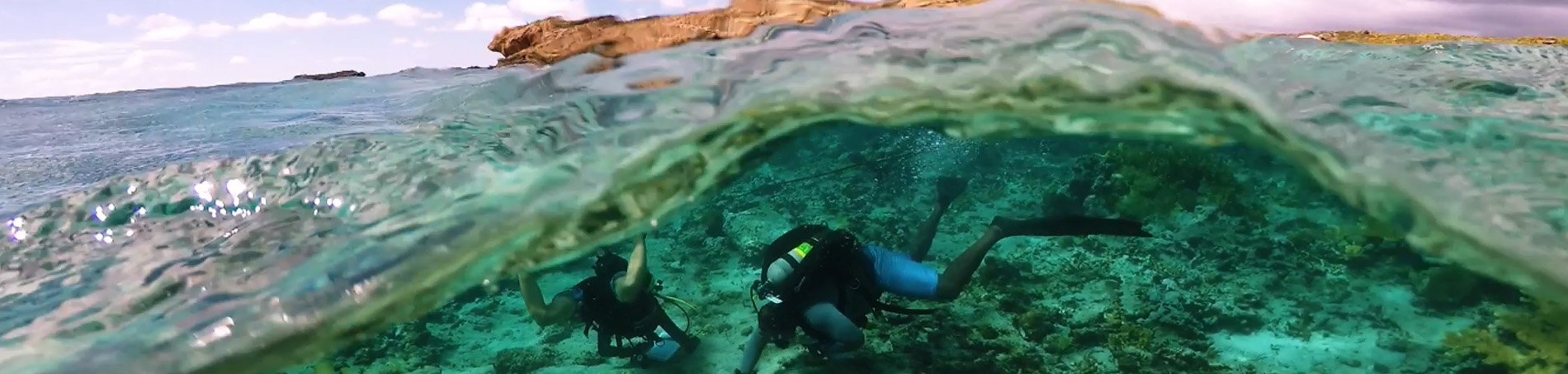
MES 511 Graduate Research Diving - A lecture and lab course designed to prepare graduate students for the rigors of fieldwork and scientific SCUBA diving at UVI. The course covers the physics and physiology of SCUBA diving with certification to Rescue Diver, the in-water identification of fishes, corals and algae of the US Virgin Islands, and research techniques for measuring and sampling reef communities. We will also introduce boating and general water safety. One 50-minute lecture and three hours of field/laboratory per week. (F) 2 credits
MES 520 Data Wrangling and Introduction to Geographic Information System (GIS) Applications - This course provides foundational skills in data science and Geographic Information Systems (GIS). The curriculum is divided into two main sections: (1) data processing, visualization using R programming language and (2) an introduction to GIS using ESRI’s ArcGIS Pro software. Students will learn to structure data science projects, understand file types, create original maps, and utilize analytical tools to generate answers to scientific questions based on their analyses. As a project-based learning course, students are encouraged to utilize their own research datasets or they will be provided with datasets by the instructor. (F) 2 credits
MES 5XX Scientific Writing in Marine and Environmental Science - Students will learn to develop a personal writing culture that leads to a daily writing habit. Lecture topics and readings will focus on the science of scientific writing, effective messaging, and the peer-review publication process. Students will establish a writing schedule, receive an accountability partner and practice scientific writing through a variety of exercises building towards writing and submitting a manuscript for publication. Ultimately, students will be equipped with the knowledge and strategies necessary to submit manuscripts for publication. (S) 2 credits
MES 524 Marine Ecology - Principles of marine ecology introduced through reading and discussion of recent scientific literature. Course includes all topics of the undergraduate course MBI 424; additional requirements include, but are not limited to, more rigorous, extensive, and analysis of primary literature. Three 50-minute lectures per week. (S-O) 3 credits
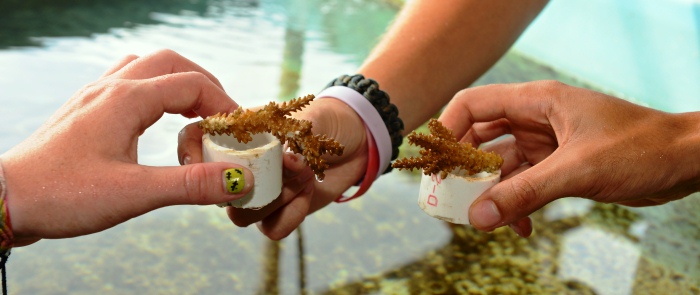
MES 530 Coral Reef Biology - A study of corals and their biology, the coral reef community, evolution of coral reefs, and the problems facing coral reefs today. Topics will include biological and geological structures of coral reef ecosystems; linkages between coral reefs and other ecosystems; anthropogenic impacts on coral reefs; and coral reef conservation and management. Three 50-minute lectures and three hours of field/laboratory per week. (F-O) 4 credits
MES 549 Aquatic Plant Biology - A comprehensive survey of aquatic plants with emphasis on marine systems. The life histories, morphology, physiology, ecology, and evolutionary relationships among the major groups of algae and flowering plants are examined using local flora as examples. The commercial uses of algae are included. Course includes all topics of the undergraduate course BIO 370; additional requirements include, but are not limited to, oral presentations of material from the primary scientific literature and completion of an independent research project. Three 50-minute lectures and three hours of field/laboratory per week. (F-E) 4 credits
MES 550 Terrestrial Plant Biology - Comprehensive introduction to plant life from bryophytes through angiosperms. Morphology, evolution, systematics, reproduction, plant identification, and other significant biological aspects, with examples taken from the local flora. Students study principles that aid in understanding the biology and ecology of terrestrial plant ecosystems and learn to use field and laboratory techniques of plant biology. Course includes all material as the undergraduate course BIO 350 with additional graduate level work including a literature search, more in-depth examination questions, and a rigorous field research project. Three 50-minute lectures and one three-hour field/laboratory per week. (S-O) 4 credits
MES 552 Plant Physiology - Comprehensive introduction to physiological mechanisms that affect plant ecological processes. Topics covered include photosynthesis, respiration, nutrition, hormones, growth, absorption, and conduction. Students study principles that aid in understanding the ecology of terrestrial plant ecosystems and learn to use field and laboratory techniques of plant physiology. Course includes all material as the undergraduate course BIO 352 with additional graduate level work including a literature search, more in-depth examination questions, and a rigorous field research project. Three 50-minute lectures and one three-hour laboratory per week. (S-E) 4 credits
MES 565 Selected Topics in Marine and Environmental Science - Topics in various fields of marine and environmental science designed to educate graduate students in areas of special interest or regional need such as mathematical and computer modelling of natural systems, coastal management, advanced geographical information systems, conservation genetics, global environmental change, ecological physiology, and fisheries biology, among others. May be repeated for credit as varying topics will be offered. Variable hours and credit.
Topics that have been offered include:
• Biology of Marine Mammals, Birds, and Reptiles
• Advanced Statistics
• Fisheries Systems Management
• Human Dimensions in Natural Resource Management and Policy
• The Role of Marine Protected Areas in Ecosystem-Based Management
• Introduction to Geographical Information Systems (GIS) and Spatial Models
• Resources, Environmental Writing, and Thought
MES 567 Pedagogy and Mentoring - Introduction to techniques designed to enhance the undergraduate learning experience, including recent research on cognition and how the findings of this research can be incorporated into the teaching of undergraduate laboratory sections, supplemental instruction, and mentoring of undergraduate researchers. Students will have the opportunity to practice techniques and obtain feedback on the effectiveness of their instruction. Other topics to be discussed will include UVI policies, use of technology in teaching, ethical issues, such as confidentiality, sexual harassment, and academic integrity. One 50-minute lecture per week, or 750 minutes of contact time distributed as necessary if offered during summer session. (F) 1 credit
MES 570 Evolution - Concepts of evolutionary biology, including the molecular level, population genetics, speciation, behavior, and broad patterns of macroevolution. Course includes all topics of the undergraduate course BIO 370; additional requirements include, but are not limited to, a more intensive consideration of the application of evolutionary theory to conservation biology, marine and environmental science. Three 50-minute lectures per week. (F-O) 3 credits
MES 595 Independent Study - Reading and synthesis at the graduate level in an area not otherwise available. May be repeated for credit if different topics are studied, but the student cannot accumulate more than four (4) credits. A written proposal must be submitted by the student to the supervising professor and the Graduate Student Coordinator at least four weeks prior to registration for the course. Variable hours and credit.
MES 596 Internship - Students may participate in an internship with a natural resource management agency or non-profit organization such as VIMAS through the Youth Ocean Explorers Summer Program. Written proposals for the internship must be developed by the student and the prospective agency supervisor and submitted to the Graduate Program Coordinator and the student’s advisory committee for approval at least four weeks prior to the start of the internship. A maximum of four (4) credits can be earned, the number of credits being determined by the duration of the experience. Variable hours and credit.
MES 600 Thesis - Students seeking an MS degree collect, analyze and interpret data and present the results of this original research in written and oral form, under the direction of their advisory committee. Variable credit and hours. Prerequisites: MES 501 – 508, the Core Courses of Year 1.
MES 601 Professional Internship Experience – Students seeking a PSM degree conduct a project as they work in a professional position that will extend at least one semester at half-time work and no more than two semesters. A project report is presented in oral and written form. Variable credit and hours. Prerequisites: MES 501 – 508, the Core Courses of Year 1.